Frank Yearly’s institutionalization and mental decline
Bones & AllFrank Yearly’s institutionalization and mental decline emerge through the gap between the father Maren imagines finding and the man she encounters behind locked doors. His medication impairs his speech, his thoughts increasingly slip away, and the pages he leaves behind narrow from attempts to remember into the repeated name Janelle. The hospital visit gives Maren answers, but not the home or reunion she had hoped for.
The news and the imagined home
Before she sees her father, Maren learns from Barbara Yearly that Frank has been institutionalized for some time. The disclosure abruptly breaks the future she had been constructing: a home with him, breakfasts while he fries bacon, and the two of them listening to Revolver. Her first response is to stare at her hands and try not to cry. Then she allows herself a new, more limited hope: perhaps he is not so ill, and perhaps visiting him might still lead to a reunion. She tells Barbara she has come for answers. The visit begins, therefore, with a painful adjustment of expectation rather than with knowledge of Frank’s condition; Maren must meet the father who exists now in place of the one she had been picturing.
The hospital she enters does not match the sensational image she anticipates. In the common room, a classical radio plays while people play checkers or solitaire, write letters, or paint. Some patients wear pajamas, others ordinary clothes; Maren observes no dramatic struggle or public outburst. The scene is quiet, and its ordinary activities make the institution feel less like the theatrical asylum she expects than a place structured by routine and separation. That calm, however, does not mean freedom: as Travis guides Maren through swinging doors and along a corridor, the keys on his belt lead to a door behind which Frank is locked in three times over.
Confinement and impaired communication
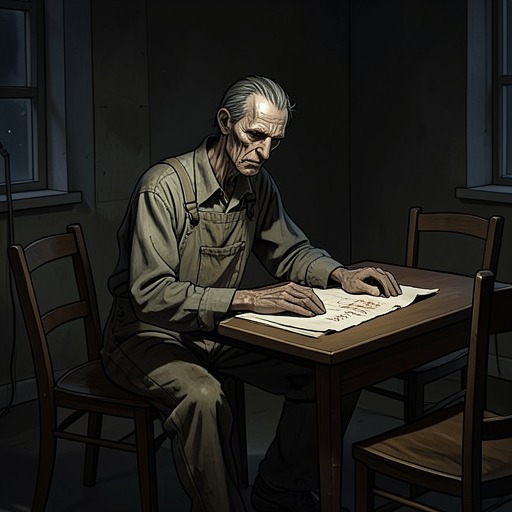
Frank is seated at a small padded table with his back to the entrance. Maren notices the bed before she sees his face: white bedding, with leather restraints hanging from the side rails. The restraints are waiting there, not described as being used during the visit. This distinction matters to the scene’s quiet menace: confinement is conveyed through the locked route, the equipment, and the threshold separating father from daughter, rather than through a visible episode of force.
When Maren greets him as her father, Frank’s eyes widen and tears run down his cheeks. His jaw works, and his lips move, but she cannot make out what he is trying to say. She asks whether he can speak; Travis explains that the medication is responsible. Frank’s distress is visible, while his words remain inaccessible. The scene offers no clinical diagnosis or account of the medication beyond this explanation. Instead, it makes the loss legible in the failed exchange itself: Maren has reached him, he reacts to her, but he cannot answer in a way she can understand.
Travis’s familiarity with Frank adds another measure of how long this separation has lasted. He knows who Maren is and why she has come. He tells her that he had tried to prepare Frank for the possibility that she would not arrive until she was older, though he does not know whether Frank understood. Maren had imagined her father waiting in a private family future; at the hospital she finds that an orderly has been carrying knowledge of her visit and its meaning. Frank’s right hand, meanwhile, remains under the table, out of view. The visit places visible feeling, impaired speech, and concealed injury together without making any one of them a complete explanation for the others.
The notebook and the failing hold of thought
Frank’s notebook records a more explicit decline than the brief encounter can. He writes that he cannot keep hold of his thoughts: an idea disappears in the time it takes to pick up a pencil. Even writing is governed by the institution. He is allowed only dull pencils, not a pen, and he speculates bitterly that someone must lick their tips before handing them over. The detail makes his diminishing control concrete: he can still record his experience, but only with limited materials and under rules set by others.
The notebook also describes forgetting as both loss and relief. Frank says that the faces of the people he remembers have gone, and that sleep now brings only blackness. The notes do not explain who those people are or offer a full history of how his condition developed. They do show what forgetting means to him: a threat to the continuity of the person he believes remains. Against that erasure, he keeps looking at a photograph of Janelle, which he takes from a drawer. He studies it when he wakes and before he sleeps, although looking pains him because he knows he will never see her again. The photograph becomes a deliberate act of remembrance, not a source of comfort without cost; Frank fears that losing her face would leave nothing of himself.
The damaged hand and the name that remains
The notebook’s form registers a further contraction. After pages of increasingly vulnerable writing, a short entry in blue-violet crayon reports that Frank’s pencils have been taken away. Blank pages follow. Then a line in red crayon says that he has ruined the hand he writes with. The sequence documents a shrinking ability to leave a record: first the effort to write is constrained, then the tools disappear, then the hand itself is described as damaged. The evidence does not spell out how the injury occurred, but during Maren’s visit Frank keeps his right hand beneath the table. When she asks Travis what the notebook means, Frank withdraws his left hand into his lap, shielding the right; his face crumples as she sees the gesture.
What follows is not a new account but repetition: the remaining notebook pages are filled with Janelle’s name, written over and over in every color in the Crayola box. The name outlasts the longer statements about thought, sleep, and memory. It is not proof that Frank can recover the relationship or that he remembers everything associated with it. Rather, the notebook shows one attachment persisting as his capacity to narrate other things recedes. Its final pages turn writing from an account of experience into an insistent trace of the person he is afraid to forget.
Narrative significance
Frank’s condition is conveyed in fragments that Maren must assemble: Barbara’s disclosure, the locked corridor, Travis’s explanation, Frank’s tears and concealed hand, and the notebook’s changing materials and increasingly reduced entries. The narrative does not supply a diagnosis or a comprehensive institutional history. Its focus is the lived evidence available to his daughter, and the limits of what she can know during one visit. The quiet common room, the keys, the medication, and the lost pencils describe different kinds of restriction without collapsing them into a single cause.
The notebook also complicates Maren’s imagined reunion. Before the visit, she pictures shared breakfasts and music; inside the hospital, Frank cannot speak clearly, and his writing is failing. Yet the visit is not empty of recognition: he responds to her presence, and his pages preserve a fiercely repeated attachment to Janelle. Those signs do not restore the family life Maren hoped to find. They make the distance between memory and present reality sharper, while showing how, amid institutional confinement and cognitive decline, Frank continues to reach for a name he fears losing.